
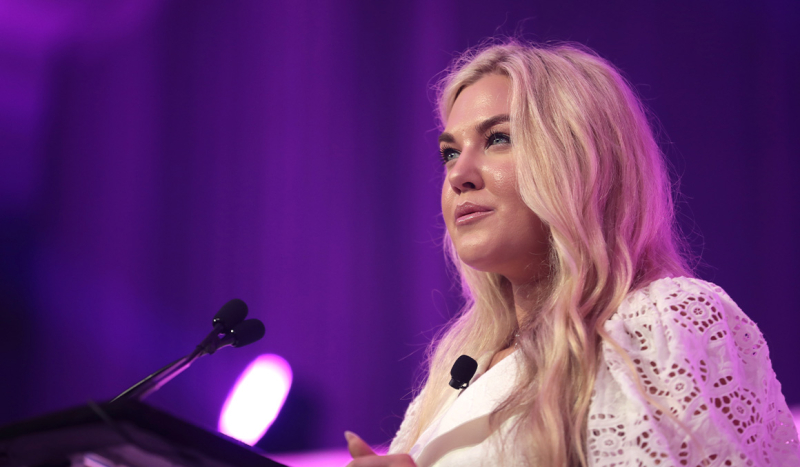
Erika Kirk by Gage Skidmore / Flickr
In the wake of Charlie Kirk’s tragic assassination, his widow Erika Kirk took to the podium with a speech that stunned the media and inspired millions. But according to religious news veteran Terry Mattingly, much of the media missed the deeper meaning of her words — largely because they simply don’t understand the language she speaks.
Writing in a Sept. 19 Substack column, Mattingly — an Orthodox Christian journalist and longtime observer of American religion — argues that Erika Kirk’s speech was deeply misunderstood by many in the press because it was delivered in a language they don’t recognize: the language of faith.
Her address was unapologetically spiritual and emotionally charged. She declared: “You have no idea what you just have unleashed across this entire country, in this world. You have no idea. You have no idea the fire that you have ignited within this wife. The cries of this widow will echo around the world like a battle cry.”
“Our battle is not simply a political one,” she continued. “Above all, it is spiritual. The spiritual warfare is palpable.”
According to Mattingly, such language is not rhetorical flourish — it’s theologically grounded.
“‘Spiritual warfare’ is a complex term,” he wrote. “At the very least, in a biblical context, it declares the reality of a spiritual realm of heavenly hosts and demonic forces, of principalities and powers in life, that transcend what people can see with their eyes.”
He noted that Erika Kirk is a daily Mass Catholic pursuing a doctorate in biblical studies from Liberty University. Her words, Mattingly explained, resonate with a wide swath of believers.
But mainstream journalists largely failed to grasp that. Mattingly points to The New York Times, which ran the headline: “Grieving in Public, Erika Kirk Melds the Personal and Political.”
“It’s interesting that the Gray Lady’s headline didn’t contain the term ‘Christian’ or even ‘spiritual,’ even though that kind of content dominated the speech,” he said. “It’s almost like politics is ‘real,’ while ‘religion’ is not really ‘real.’”
The Times article framed Kirk as extending her husband’s “inflammatory rhetoric” on controversial social issues — even though she did not mention any of them in her speech.
“It’s almost as if Erika Kirk was speaking a language that most mainstream journalists do not understand, except in political terms,” he said.
He went on to challenge the implication that her views were extreme or isolated.
“There was no need to note that the Kirk family’s beliefs on sexual morality and marriage are consistent with the doctrines of traditional Catholics, evangelicals, Eastern Orthodox believers, most of global Anglicanism, Orthodox Jews and many others in ancient faiths,” he said.
The backlash was intense. A viral post with a photo of Erika standing at her husband’s funeral read: “She’s as hateful as her husband.”
“That post has since been deleted — although not before it racked up over 140,000 likes and more than 12,000 retweets,” Mattingly noted.
He pointed to an observation from novelist Kat Rosenfield, who captured the underlying tone of many responses.
“[R]esponses like these convey a lemon-faced, tsk-tsking sense that Erika Kirk has done something distasteful in vowing to continue her husband’s work,” Rosenfield said, “and that if she had any decency, she would have made a conciliatory statement about the need for unity before retreating into the shadows to grieve, maybe not forever, but at least for long enough to allow the whole organization her husband spent his short life building to fall into disrepair, rust over, and collapse into nothingness.”
Mattingly closed by raising the question at the center of the media’s discomfort.
“Should Erika Kirk have crafted her message in a way that reached her target audience, but avoided what she, and the Turning Point USA staff, surely knew would be dangerous lightning flashes of rhetoric to journalists?” he said. “In other words — should she have avoided ‘Christianese?’”
In the end, Mattingly suggests Erika Kirk’s real offense, in the eyes of many, wasn’t political at all — it was spiritual clarity spoken in a language much of the press never learned to hear.
>> Erika Kirk forgives her husband’s killer in emotional memorial address <<
